
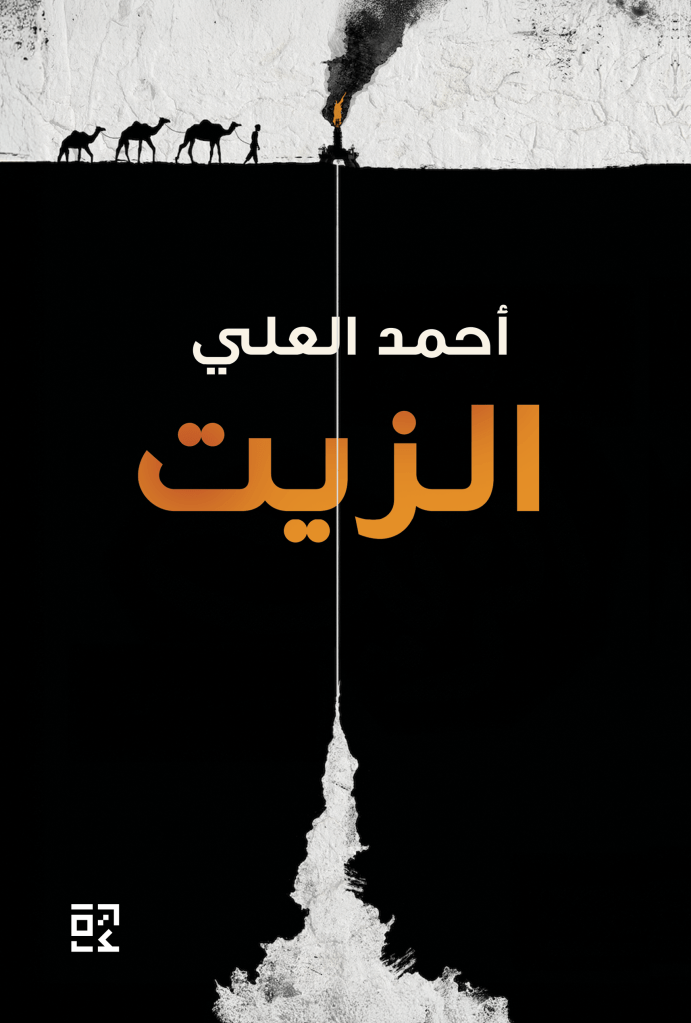
يصدر هذا الكتاب بمناسبة مرور 100 عام على نشر كتاب “ملوك العرب” للأديب والرحّالة أمين الريحاني.
هل يمكن تقديم “التاريخ” في بناء بانورامي، يتناوَب في رفْع أعمدته السّرد والشعر، النّقل والاقتباس، الترجمة والتحرير، البحث والتحقيق، المراسلات والوثائق، الصور الفوتوغرافيّة والذاكرة الشفهيّة؛ ليغدو حالةً تُعاش وليس حدثًا يُقال ويُروى؟ هل بالإمكان العمل على خامَة تاريخيّة تذهب إلى الدراما سردًا وشعرًا وتوثيقًا، وتنحو إلى اكتشاف الحدَث المُثير المنسي أو البعيد؛ خامَة محبوكة من مواد أدبيّة متنوّعة لرسم شخصيات عاشت في مراحل زمانية عدّة مرّت على بقعة مكانيّة واحدة؟
اختار الكاتب أن تكون البُقعة هي منطقة الأحساء، شرقيّ المملكة العربية السعودية، التي عُرفَت تاريخيًّا بنخيلها وعيون مياهها، فهي أكبر واحة نخيل في العالم، ومسجّلة بهذه الصّفة في قائمة اليونسكو للتراث العالمي. لكن اكتشاف النفط فيها غيّر حياتها، وقُدّر لها أن تحوي أكبر حقل نفطي في العالم أيضًا. وهنا، يتتبّع الكاتب حياة تلك المنطقة قبل اكتشاف الزّيت وبعده، في فصول تتوالى لا بالخط الزمني، بل بالإثارة الدرامية: من خيمة الرحّالة أمين الريحاني في ميناء العقير في الأحساء، إلى مجلس الملك عبدالعزيز في الرياض، إلى قصر محمد علي باشا في القاهرة، إلى فيلبي في بار السّان جورج في بيروت، وصولًا إلى الحقول التي شهدت ميلاد عصر الزيت. يبدأ كُلّ فصل باقتباسات يأتي بها الكاتب من مصادر مختلفة ليغْزِل بها سرديّة تاريخية حول تلك الحقبة وشخصياتها، ثم يتبع الاقتباسات بكتابة أدبية ذاتية متعددة الأشكال، يُحاوِر فيها الكاتب من لحظته الزمنيّة الحالية ذاك التاريخ كلّه، ويسأل عن المستقبل.
هذا عمل أدبي/تاريخي يضع القارئ في بؤرة يرى من خلالها كيف شكّل اكتشاف الزّيت التاريخ الحديث للخليج العربي والجزيرة، حتى أصبحت من أهم مناطق العالم، وفي أوائل نشرات الأخبار بوتيرة يوميّة، والقيَم التي تبنّاها إنسان المنطقة لتحقيق ذلك من التمسُّك بأجمل العادات والتقاليد المحليّة الإنسانية التي تشكّل هويّته، فيما يفتح نوافذه لرياح المثاقفة والحوار، ويُقيم للتسامح والاعتدال والتعايش بين البشر موطناً لا يزول؛ ذاك كلّه في سرديّة تاريخية وشعريّة منسوجة بدقة، كتبت بوعي التاريخ وحرارة الحكاية وقلب الإنسان.
Saudi author Ahmed Al Ali’s Oil is a conversation across time between Al Ali iconic author and voyager Ameen al-Rihani (1876-1940), a panoramic and kaleidoscopic look at the history of eastern Saudi Arabia using poetry, narrative, reports, and correspondence. In this, it echoes Tim Mackintosh’s Travels with a Tangerine, where he recreates the journeys of Ibn Battuta, or John Ashbery’s poetic-historical collage, or, of course, the groundbreaking novels of Abdul Rahman Munif, which trace the changes that came with the discovery of oil.
The back cover of the book asks:
Is it possible to work with the raw material of history to produce something dramatic narratively, poetically, and documentarily, seeking to uncover incidents both forgotten and remote – raw material crafted from a variety of literary genres to depict characters who lived in the same part of the world over successive and varied time periods?
And indeed, the book’s interior answers the question: Yes.
The text focuses on the sweeping al-Ahsa’ region in eastern Saudi Arabia, historically famous for its date palms and fresh springs, and recently designated a UNESCO World Heritage site. However, the discovery of oil completely changed the lifestyle of that region, which is home to the largest oilfield in the world. In this work, the author traces the life of this region both before and after the discovery of oil. The book begins with the voyager and Lebanese-American writer Ameen al-Rihani, visits the council of King Abdul-Aziz in Riyadh, stops in with the famous spy Kim Philby in the Saint-George Hotel Bar in Beirut, and returns to the vast oil fields and changes of the era. Each chapter starts with quotations from the era, followed by the author’s own dialogue with history.
This is a historical narrative – for those who are interested in both poetry and history – helps the reader see how the discovery of oil shaped the history of the Gulf and the Arabian Peninsula. It is both interesting in its content and form, and would be of particular interest to students of social and cultural change.
*
Back Cover:
This book commemorates the 100th Anniversary of the Publication of Arab Kings by author and voyager Ameen al-Rihani.
Is it possible to present history by using a panoramic structure, the pillars of which alternate between narrative and poetry, reports and quotations, translation and editing, research and revision, correspondence and documentation, photographs and oral memory, to make of it an event to be lived rather than a story to be recounted? Is it possible to work with the raw material of history to produce something dramatic narratively, poetically, and documentarily, seeking to uncover incidents both forgotten and remote – raw material crafted from a variety of literary genres to depict characters who lived in the same part of the world over successive and varied time periods?
For the specific part of the world, the author has chosen the al-Ahsa’ Region, in the east of Saudi Arabia, historically famous for its date-palms and numerous springs; in fact, it is the largest date-palm oasis in the world, and is registered as such and designated a UNESCO World Heritage site. But the discovery of oil completely changed the lifestyle of that region, which, as fate would have it, contained the largest oilfield in the world as well. In this work, the author traces the life of this region both before and after the discovery of oil, in chapters that only follow each other in a chronological sense and in dramatic suspense: from the tent of the voyager Ameen al-Rihani pitched at the port of ‘Uqayr in al-Ahsa’, to the council of King Abdul-Aziz in Riyadh, Saudi Arabia, to Sultan Muhammad Ali Pasha’s palace in Cairo, Egypt, to the famous spy Kim Philby in the Saint-George Hotel Bar in Beirut, all the way to the fields that witnessed the birth of the oil era. Each chapter starts with quotations cited by the author from various sources to weave his historical narrative of each era and its foremost figures; the quotations are followed by an idiosyncratic and subjective narrative that takes many forms, where the author, from his own moment in current history, engages in a dialogue with this vast history, and poses questions about the future.
This is a historical narrative work that puts the reader into a spotlight through which one may see how the discovery of oil shaped the modern history of the Gulf and the Arabian Peninsula and made it into one of the most important regions of the world, in the headlines and among the top stories daily. It reveals the values adopted by the people of that region to achieve their ends of remaining true to their most beautiful local human traditions which shape the identity of that place, while simultaneously opening a window onto the winds of cultural change and dialogue, thus establishing a lasting homeland for tolerance, moderation and co-existence. All this is evoked in this finely-spun historico-poetic narrative, penned with deep awareness of times gone by, a passion for storytelling, and a profound connection to the human heart.
*
Oil
By Ahmed Al Ali
Translated by Sarah Enany
PART I
Al-Rihani’s Journey
Chapter One: In Search of Musk[1]
| Maker of Modern Arabia Ameen al-Rihani Houghton-Mifflin Boston – New York 1928 |
Seven years remain,[2]
During which I might die or be granted life
Long enough to see this book’s centenary.
A book about land
That must needs bring in the color blue.
The scent of a century’s worth of storage,
A camel or two,
And a saddlebag or two.
A great many garments and lanterns
And circles of men seated on the ground,
And this is the story of that land:
How shall you tell it to me
In what remains of your seven years
In my house?
***
You showed them the way;
I let them flow in my tongue’s deep waters.
If your spirit be here,
Move this darkness a little:
The dark in my room, around my tree-trunks
In the bosom of the sanctified city.
The blood of our letters is still under their fingernails
In Oxford;
Whenever they pronounced the qaf, the Bedouins’ eyes shone:
“They are one of us!” They were not.
They were the cold death of us beneath the ghostly stars.
You showed them the way
To our sleeping turbans, safe among the sand-dunes.
The Sultanate of Najd and its Territories
| Its Sects: Wahhabism, Shiite Islam, some Sunni Islam. |
I came to the island in the night.
I lit the lights in the house called Atric.
I found the lonely cold exhaling by my side;
I had been the heart that saw,
The star prostrating itself upon the rain-slicked earth.
I stayed within books that do not speak,
No-one’s guest.
If I scoop up the damp earth between the alleyways and the palm-trees,
I am no guest; for I mourn, and am mourned.
I shift my soul from stone to stone
And light up Atric, my home.
I know the voice that whispers in the darkness, and it knows me.
I opened up the wailing within the people, warning and long-drawn-out.
The Imams and Kings of Saudi Arabia
- Man Proposes, God Disposes
- In Baghdad
| I was not granted permission to travel to Bahrain. (…) I arrived at the Agency headquarters on the Western coast to meet Lady Gertrude Bell, the secret-keeper of the High Commissioner on Eastern Affairs, whom the Iraqis call Al-Khatoun (…) As she took the reins of the conversation, she smoked cigarette after cigarette. |
The secret lies in one’s breast.
I know of no other place of safety for it.
The oil lies in the earth.
I know of no other place of concealment for it.
Graves within graves,
While the gate to the island has no bell
And its night is reed-mats of black.
The fall of a fruit from a date-palm reverberates,
With an echo heard in distant oceans.
O spirit of vacancy that has wandered upon the sands
As a garment for the deserts of al-Dahnā’, fill up, now,
Before the machines make their entry,
Ponderous as the weight of a handshake of condolence
Before they ever burst out into clangor and force;
Secrets without a breast;
Oil without a land.
| She was still suspicious of my intent and conduct in Baghdad. Was I there to speak of Arab unity, or to stoke the flames of rebellion against the British? Was I there to support the National Party, the Free Party, or the mandatory authority; or was I perhaps a secret messenger from America representing some oil company or another? |
I see you
In the gazebo, yawning, with eyes that have tired of your disguise
Among the palms and other trees so that I may see you.
The clouds are bones that have been eaten away;
Betrayal lies within people like dates in their storehouses.
Did you think me inattentive?
The further your eyes – which Life makes you forget –
move away from me, the more firmly I trap your soul in them.
With your death, our friendship shall begin anew,
With the death of the leprous ‘I’ within you.
| Afterward, I met the High Commissioner, Sir Percy Cox. He was the reverse of his secret-keeper, the Khatoun, in that he immediately spoke first to his guest. (…) I was greatly pleased, despite my incredulity, when the High Commissioner said, “I shall soon pay a visit to Ibn Sa’ud.” I saw myself – for what good are imagination and dreams if they grant you no part of their bliss? – I saw myself travelling alongside him to Al-Ahsa’. |
Time does not exist in Najd.
It inhabits not, nor is it inhabited.
The desert scrub brush is never youthful; the water never quenches.
Only poetry takes on various roles in these lands,
Now speaking of war, now of love,
Now of family history, now speaking words of wisdom.
A theater under a never-setting sun,
Where if you should cry: “Over there!”
A thousand strangers will burst forth from the sand.
[1] This chapter is based on quotations from Ameen al-Rihani’s English-language book, Maker of Modern Arabia, and is organized based on al-Rihani’s chapterization. Translations into Arabic of these quotations are by the author, except where al-Rihani translated into English complete parts of the Arabic texts Muluk al-‘Arab (Arab Kings) and Tarikh Najd al-Hadith wa Mulhaqatuh (The History of Modern Najd and its Territories), which were located in the original by the author.
[2] Footnotes in the original will be quoted in the Appendix.
 Ahmed Al Ali I أحمد العلي