دار طوى للنشر والتوزيع (لندن) – دار الجمل (ألمانيا)
مجموعة كلمات – الشارقة
“الله! إنّي أقولها صادقًا لحدّ اليقين يا أحمد العلي: إنّ ما تكتبه ليس عابرًا، ليس عابرًا أبدًا ولا يكتنفه الادّعاء. إنّ حبرك دم القلب، وأبجديّتك بوصلة الكتابة. ومن لا يقرأك فقد فاته خيرٌ كثير وعِلْمٌ وفير. وأقولها باطمئنان كثير وثقة أكبر، ويقين لا مُتناه: أحمد العلي هو مستقبل الصّحافة الثقافية في مشهدنا المحلّي؛ عينُه لاقطة، ولُغته راصدة، ومواضيعه مبتكرة، وأفقه رحب.
هاشم الجحدلي
“في كلّ عبور له من نصّ إلى آخر، من جسر إلى آخر، كان لا يعني نصّه سوى أن يصعّد من حواسّه ويكثّفها، ويفتح عمَلها على آخر ما تستطيع أن تقوم به من حركة وسرعة ونمو. عمله الأخير يشي بذلك، نصٌّ بصرُه حاد، يخترق اللحظة والذاكرة دون أن تُلغي إحداهما الأخرى..
محمد الحرز
*
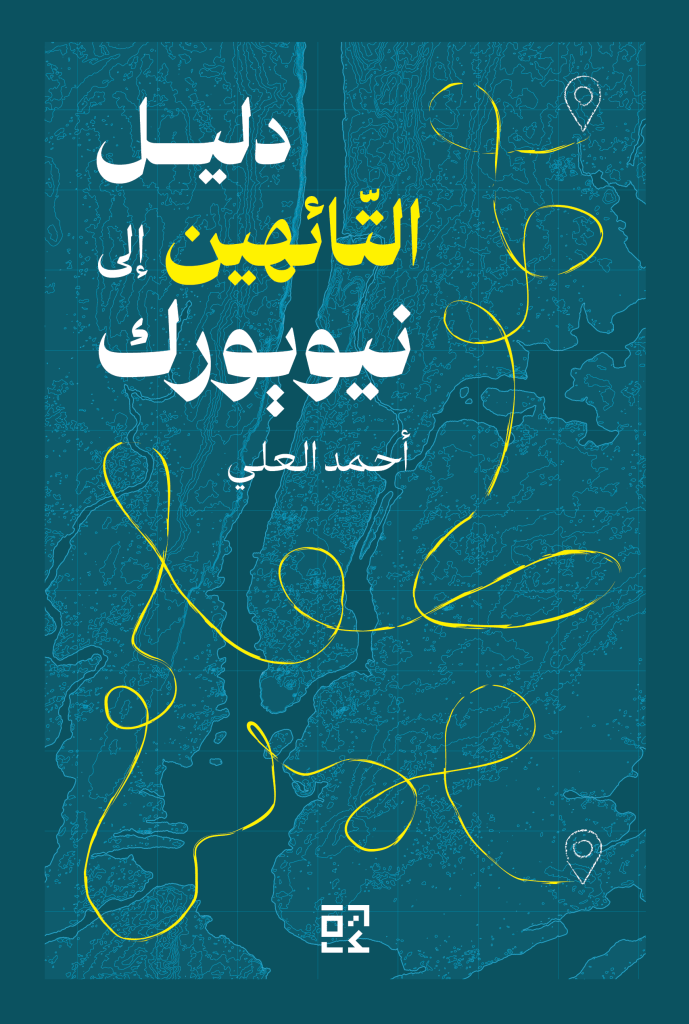
بعد ابتعاثه للدراسة في نيويورك، يسجّل أحمد العلي تفاصيل عاشها في متاهات تلك المدينة، توهّجَت حتى صارت حياة النص، الذي يُبرز قُدرة الشاعر العلي على التعبير عن مشاعره الإنسانيّة العادية والبسيطة للأرض التي وطأها، فيقول عنها: تبدو نيويورك ملفًّا مضغوطًا للعالم. يذهب الشاعر إلى المتاحف والمعارض والحدائق، يسير مع إدغار آلان بو وبيكاسو ودالي ولوركا، يقفز من التايم سكوير إلى الوول ستريت، يرى مخطوطات تعود لبيتهوفن وموزارت وأنشتاين وداروين، ويقابل صانعي أفلام لايف أوف باي و فانديتا. تلك التفاصيل ينهض بها السّرد بين الخارج والداخل، وبصيغة المتكلم، حيث تتناسل المشاهد، تتقاطع وتتداخل، تتشابه وتفترق، وتشكّل جميعها رحلة المؤلف التي يتم قولها بطرق متعددة، وعبر عناوين مثل: يشيخ أمام الشاشات، رسالةٌ تبصق دمًا، بوستر مقترح لفيلم خروجك من الغابة، الهارب من الحفل قبل نهايته، غراتسيا!، قفص هانيبال، وعناوين أخرى.
Ahmed Al Ali’s A Wanderer’s Guide to New York follows its narrator as he journeys between present and past in a narrative of lost loves and lost pasts evocative of W.G. Sebald’s Austerlitz and Teju Cole’s Open City. Like Sebald and Cole, A Wanderer’s Guide is concerned with memory and its loss—most particularly with maps, manuscripts, handwriting, and calligraphy—on the way to finding lost connections.
In prose that veers between poetic and journalistic, A Wanderer’s Guide describes the complexity of being the Other and the yearning to belong to a geographical space. Through visits to museums and other locations around the city, the narrator obsesses over the traces left behind by others as he follows the trail of a lost love.
In this crossroads of cultures, the tours cover a wide array of topics—although return us to the same thematic concerns. We journey from World War II, to Existential poetry, to famous historical figures: Mozart, Van Gogh, Walter Whitman, to Arabic and Islamic heritage.
Each chapter is divided into three or four sections that connect to a single theme or single location. At times, as in the chapter “And So Sings Bob Marley” and “And So Sings Marcel,” the narrator tries to find differences between the Arab world he left behind, and the one he is trying to make sense of in New York. At others, he searches for similarities. The book ties all these themes together by ending on a confessional note, about a connection that ties his lost love to a friend of his, Marcel.
Critics have said:
“His ink is the blood of the heart, and his alphabet the compass of writing… Ahmed Al Ali is the future of cultural journalism.” — Hashem Al-Jahdali
“A text with piercing vision that penetrates moment and memory, without one erasing the other.” — Mohammed Al-Haraz
Author Ahmed Al Ali is a poet, editor, translator, and publisher who has brought out three poetry collections and a prose work about New York City. He has also translated a number of iconic works into Arabic, including Paul Auster’s The Invention of Solitude and Elif Shafak’s Black Milk. You can find more about the author at https://alaliahmed.com.
*
A Wanderer’s Guide to New York
By Ahmed Al Ali
Translated by Sahar Othmani
The Guide
Life is tested through geography. A person who is stagnant within the bounds of his one-and-only environment forgets that the world’s topography is diverse. But when he sets a foot into foreign bodies of water, blue as ever, a coffee plant blooms in his chest, and the leaves of realization begin to bud.
An image has three dimensions, moved along by the wheels of time. Poetry has dimensions that are taken in by the gaze of eternity: one for nighttime, another for regret, and one more for disappearing into crowds and breathing in the depths of one’s drowning. As a person piles on his various dimensions, he steps out of the poetry of a room full of telescopes, beakers, and the electricity that courses like blood through the screens of devices. He steps into a room for poetry where his flesh must be scrubbed with feather and fur, and scratched by fangs, and bulldozers, and thorns, and joy. A room where air stacks up as death camouflages itself among the bystanders, where bridges become puzzles, and where the hearts of small shops—as well as the openness of playgrounds—can be found.
New York was a room of my own. And if I ever felt parched, I would reach for Manhattan, its fridge.
A Letter Spitting Blood
(they were gathered around the table, chatting and chuckling as I wrote)
1
Bad handwriting is an eyesore is an old Arabic adage.
A certain father of surrealist art named Salvador Dali was the first to draw my attention to the swooping style of penmanship. He had incorporated penwork into much of his art; he would give an elephant the long limbs of a giraffe, so that it could reach into the clouds. And because surrealist painters could not bear to leave calligraphy alone, and because they wreaked a loving havoc on it, Dali had a friend, the Spanish poet Fredrico Garcia Lorca, who also had his way with pens. Lorca would start writing the L in his name from the top of the page and end it at the bottom, turning the letter into an umbrella’s curved handle. As for the F, he would start in the middle of the page and stretch the letter downward. And for G, he would draw a circle in the shape of the snail’s conch and extend the rest of the letter to the bottom in a broad curve that resembled a fisherman’s hook.
Anyone familiar with the writing of Nizar Qabbani would recognize that his handwriting was as neat and meticulous as a woman’s fingernails. Like him, Khalil Gibran was influenced by the charm of Maghrebi calligraphy. And if you blended the two authors’ styles with the elongated cursive of Lorca’s handwriting, then the glorious, artistic penmanship of Adonis would jump out at you.
And from all that, I emerged with handwriting that is as dark and tangled as tree branches. I sheathed my lousy pen; I would not have been able to start if I hadn’t put my mind to writing the entire Quran using one uniform style of calligraphy. Except that, when I was finished with the chapters of Al Baqarah and A’nisa’, I thought I’d had enough practice for my hand to finally find its own rhythm. Instead, I saw that my grandfather was right when he said: you can fix anything, but not the writing of a person’s hand; you need to be born again to fix that.
Those weren’t the only people whose handwriting I had studied closely: There was the script of Ounsi Al Hajj, Saadi Yousef, Abbas Beydoun, Mohammed Bunees, Qasim Haddad, Mohammd Al Thobaiti, Ahmed Al Mulla, and many other writers. I also studied the handwriting of my own family: my father, grandfather, his siblings and even my great-grandfather—all of them signed their initials on the first pages of their books, inscribing their own wills in pen.
2
With eyes turned almost blind—like Jacob’s cataract-filled gaze—I felt Jacob’s hope that the shirt of language would be thrown on my face, so that I regained my vision at any moment. I stood in Manhattan, in front of manuscripts and handwriting for which I was not prepared. I saw a rare dedication of the German Nazi leader, Adolf Hitler, on the first page of his book, Mein Kampf. The dedication was signed on Christmas Eve, 1920.
His hand appears happy. Perhaps it spilled a drop of champagne onto the dedication page (that yellow stain in the corner—can you see it?). Or perhaps it is from the butt of a cigarette that burned into the page as he drew it closer to his face. Hitler’s handwriting, in a language I do not understand, looks like wooden electricity poles that connect only at the top, while a multitude of birds land on their lines. He drew the letter H, at the beginning of his name, in the shape of a mathematical infinity sign (∞). But it is broken in the middle by something mysterious. It’s as if there were a hidden, endless labyrinth to which he found a door, then peeked through. Perhaps he knew his life would end in suicide. That might be the reason why he never wrote his name unless it was in the shape of a curved cliff, or the edge of a table: it starts straight and then slowly curves and curves until it bunches up completely.
The exhibit was at the World War II Museum in New York. (Manhattan was considered the first port in the world, and Brooklyn was the US’s control room during the war.) As I stared at Hitler’s hand, Einstein’s was there at my back. I saw it in the reflection of the glass, so I turned around.
One river away from where I was right now, Einstein had died. The place where he was cremated, and the location of his ashes, are unknown. His doctor took his brain and kept it. And I found myself staring at a letter he had penned, addressed to President Roosevelt, demanding that the president fund the Manhattan Project to create the nuclear bomb. This paper was a seed of murder, the seed of Hiroshima and Nagasaki, a knife aiming its first thrust into the soil of this land. This was Cain’s hand, one that resembled time: it goes, it melts away, it and cannot be held back. The writing wasn’t neat, but it was firm enough. The fiber of the paper lacked the freedom to choose how to absorb ink as it pleased. This writing was a clock that ticked twelve times at the twelfth hour.
Another concluded that we were all the result of two mathematical processes: Addition and subtraction. This, too, was what Darwin tried to prove with his tree of life, which was drawn on this paper. What madness: a tree with a bush of a top and two stumps. From this tree sprouted words, and I could not determine whether they belonged to each branch, or whether they belonged to the clarifications of the theory composed by Darwin himself… It was as if he wrote using a bird’s beak, because he could pay no heed to much besides the clouds. Or perhaps he wrote with the small fingers of his little one, taken too soon by sickness, which made him fear this universe. Which made him ready to share all his secrets.
With my head low, I left the Darwin exhibit at the Museum of Sex and walked to the public library. The sound of my heart beating was louder than anything else. Louder than my heart itself.
3
His belongings: His artwork and manuscripts, photographs and first editions of his book, and his guitar—all of this was surrounded by letters he had written to his family. He had most particularly written to his sister, who had possessed the red leaf and pinned-up hair. Those letters brought warmth to the space. There was nothing particularly special about them, except for the sentiment that radiated out to anyone who stared at them until they, too, fell into memories of their own families. Each of their faces floated onto the reflection of the glass only to sink down once again. That night . . . that night I slept at my grandfather’s house, in his bedroom, somewhere far away
If there ever was to be a font dedicated to the traces that wild horses left as they raised their heads into the air, it would have to be this one. Here, our master Lorca has the ability to adapt his hands to the content of a text. If he faced a letter, he tamed its wildness, buckled into the saddle, and tread lightly until he reached his destination. If it was poetry, then close your eyes: these hands would flow like a person loosening his grip on the strings of a guitar. You would find that there were more scribbles on a page than writing; circles surrounding stanzas and moving them from one spot to another, spaces vast enough for birds to take flight, and arrows pointing to the back of a page, as if you might be flipping the space as one flipped a table, or as if you were staring at the sky from a higher vantage than Earth. You would flip the page upward so that the light from the ceiling seeped through. It was akin to turning a precious gemstone toward the light so you could inspect its authenticity. Your eyes would see what no one else could, and they would read what Lorca had written for you and only you. You would see it only once, and then it would disappear forever.
The whole jazz concert with its players—and the darkness of its stage and golden tears falling from the eyes of friends—all of that, I lived through Salvador Dali’s letter to his friend Lorca. Dali’s letter was spitting blood. Dali’s letter had no healing presence. Instead, it was nearer to a report on a criminal investigation. He underlined several sentences and divided the letter into sections. When he sensed he was running out of space on the page, his hands struck out near the margins and breathed in any possible space. I believe he passed out before we was able to finish it, and it was sent on his behalf. This is how a person tends to be, and this is how endings work. Everything runs out all of a sudden, and you, too, run out, slipping from the hands of others. Dali ran out, but his letter still coughs and spits blood.
4
This is the pavilion of the sheikh of all geographers, Al Idrisi, and this is the maps section at the library where Columbus, Maltese sailors, and the pirates of Oman hunker behind a door, awaiting my arrival.
The drawing of a world map—does it seem easy? Does it seem normal? To draw the map of an entire planet: can you imagine what this must entail? It entails dividing your self in three: the sail, the protractor, and the compass. It means touching the edges of entire continents with the tips of your fingers as you set sail. It means wiping sand away here and there, so you can plant a mountain or a castle as you peer at the paper with your protractor. It means a miracle. A miracle, like how a father immediately falls in love with his newborn the moment he’s told, this is yours. A miracle isn’t what happens with a mother, since that is mysterious, cavernous, and hard to explain. An intimate physical bond established by prolonged contact, such as can happen with a pillow, a ball, or a cat. The miracle in a man is how easily he finds belief, how he bets on things, and how he puts effort into what unravels him, prompting him to act until he arrives at a point in the middle of a day when he stumbles. He cries out: I did not fall! I just blinked too fast, and then I don’t know what happened after.
 Ahmed Al Ali I أحمد العلي